

Notary Public Underwriters Blog
Will AI Replace Notaries? Why AI Could Be a Notary’s Tool—Not Their Competition
- Details
- Published: December 15, 2025
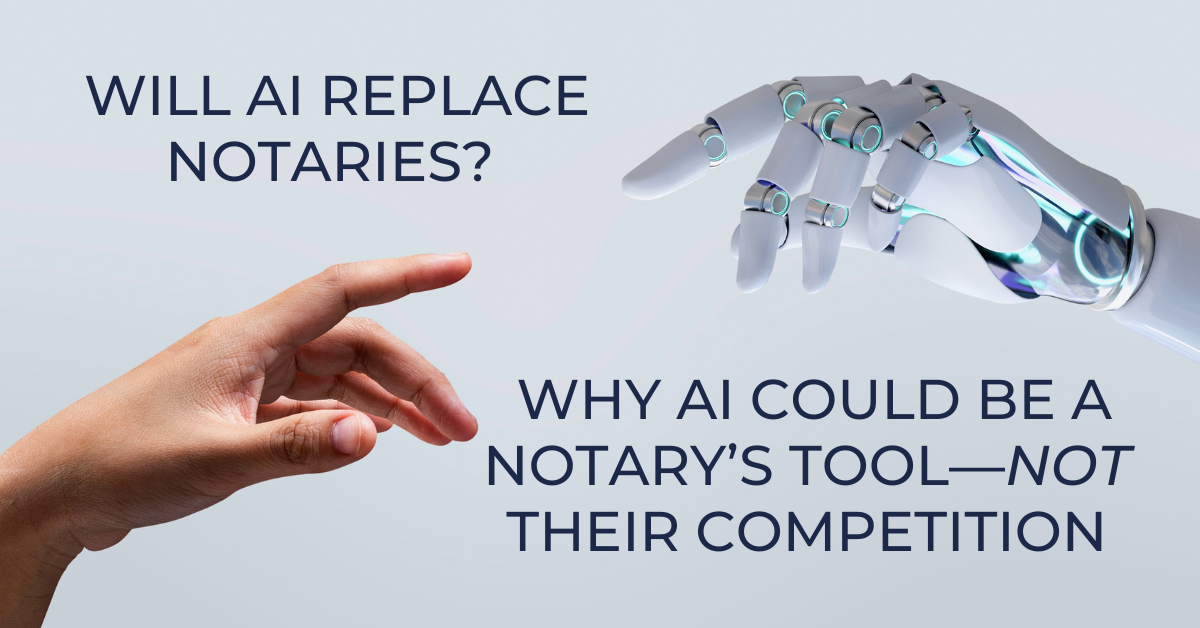
Artificial intelligence (AI) has become part of daily life, offering efficiency and convenience across industries. But when it comes to notarizations, AI serves as a helpful tool—not a replacement for the human notary public.
What AI Can Do
Today’s AI technologies rely on information they are given or can access through databases, APIs, and other sources. That information may be written or audible. AI can also interpret certain human cues—such as facial expressions or tone of voice—but it lacks human consciousness and the lived experiences necessary to make actual decisions based on that capability.
Why Human Notaries Are Essential
AI’s lack of humanness is the very reason that a live notary public is so essential to the integrity of transactions. Like AI, a notary relies on information presented to them. But unlike AI, a notary public is a living, breathing human whose own life experiences enable them to not only observe or receive, but also interpret that information and reach reasonable conclusions about a person’s willingness to sign a document, give their act of signing greater credibility by having it notarized, and abide by the effects that the notarized document is intended to have. In short, notaries provide both judgment and accountability—qualities AI simply does not possess.
Accountability Matters
Notaries are held accountable for their notarial acts and the decisions they made in performing them. Under the state laws and administrative rules that govern them, notaries can be punished or at the least reprimanded when they fail to perform in full compliance with their governing laws and administrative rules. Artificial intelligence as we know it today is still a machine that—unlike a human notary—is not morally accountable for its actions.
How AI Can Help Notaries
Although AI can’t replace a notary, it can still offer valuable support. For example, AI can assist with:
- Automatically scheduling appointments
- Document management
- Assisting with research or fact-checking
When used properly, these tools can save notaries time and streamline workflows.
The Bottom Line
AI is a powerful resource, but it will never replace the personal involvement of a commissioned notary public. Notaries must continue to follow the laws and rules that govern their role, personally carrying out each step of a notarization.
In the end, AI can support a notary’s work—but it can never be the notary.

Related Article(s)
Do Notaries Need E&O Insurance? The Truth Every Notary Should Know
Can a Notary Completely Protect Themselves From Being Sued?
What Questions Should a Notary Refuse to Answer?
Fighting Fraud: Why Notaries Should Avoid Using Signature Stamps
Tips to Protect Your Notary Stamp and Journal
How to Get More Notary Business Part 1: Optimize Your Marketing
How to Avoid Common Mistakes During a Notarization
When Can a Notary Use Personal Knowledge to Identify a Signer?
Does a Notary Need to See the Entire Document When Notarizing?
Can a Notary Correct a Mistake on the Notarial Certificate?
Notary FAQs: Essential Answers for Everyday Scenarios
Top Ten Mistakes That Notaries Make
Can a Notary Notarize a Family Member's Signature?