

Notary Public Underwriters Blog
Choosing the Right Ink for Your Notary Stamps
- Details
- Published: May 11, 2026
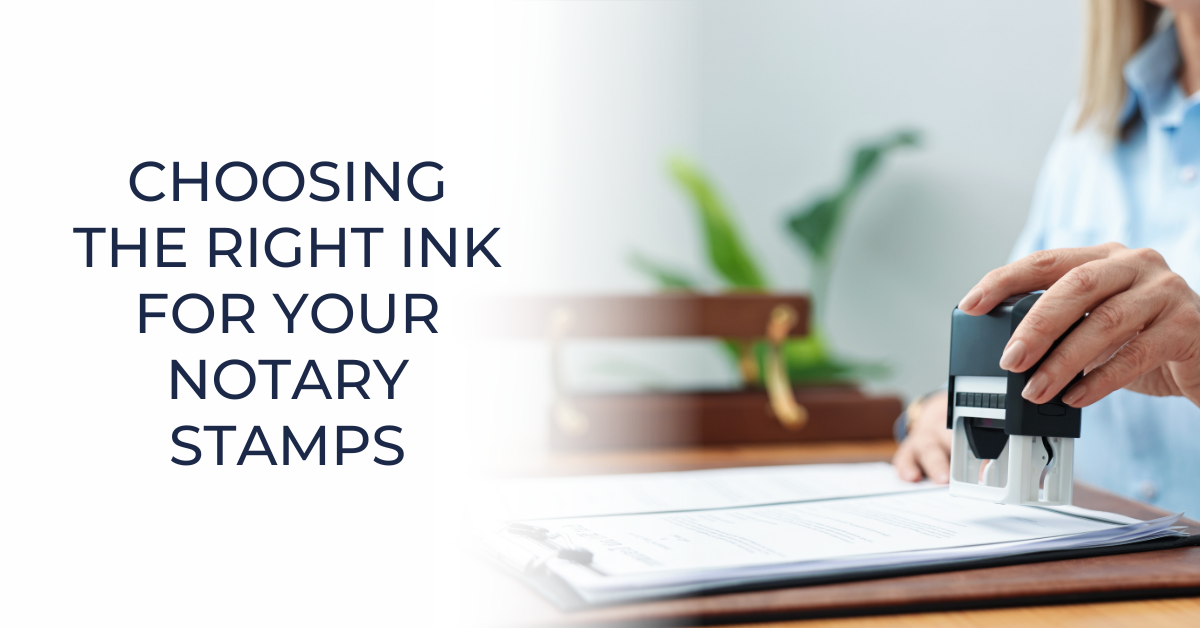
One of our recent notary blogs discussed how important a flawless notarization (every time) is. It’s because a document containing your completed notarial certificate could be kept for decades—centuries, even—and later viewed by future generations. (Curious? See that article here.)
A Look Back: Ink in the 18th Century
Web research indicates that in the 18th century, the ink used by the general population—including notaries—was almost exclusively iron gall ink. When fresh, iron gall-ink was generally deep black or blue-black. It was widely used for personal needs, as well as for documents of a legal or governmental nature.
But as iron gall ink aged, its color changed. To the naked eye the ink’s aged color appears somewhat dark-brown, with a slight halo effect around each stroke. We shared a fascinating, beautiful image of an aged, notarized document in our earlier article. The writing on that document appears to have been made in dark-brown ink . But based on the year the document was written and signed it was likely written in iron-gall ink that, long ago, looked black or blue-black.
Modern Ink: Built for Longevity
Today, the modern inks used in writing pens—and particularly, high-quality notary stamps and inking pads—are formulated to comply with archival durability standards that weren’t available or remotely possible 200-plus years ago. Quality modern-day inks are made to comply with globally recognized, ISO standards. The standards ensure that certain levels of ink permanence and durability are met.
Not All Ink Is Created Equal
Of course, some stamp inks and ink pads available today don’t meet these standards for various reasons, including that long-term, archival permanence and durability aren’t priorities for the users. But for notaries public, whose notarial acts appear on documents that could be relevant for years, decades, centuries or for all time, only stamps containing inks meeting the ISO standards should be chosen.
Rest assured that all ink stamps and ink pads obtained from Notary Public Underwriters, Inc. meet the ISO standards for archival permanence and durability. Whether you choose a traditional wooden-handle stamp, or a self-inking stamp from us, you also get our stamps’ lifetime guarantee.
Remember, complete your notarial certificates using “permanent ink” writing pens. And don’t risk performing your notarial acts with a stamp or seal that could fail to leave an impression that stands the test of time.
You’ll never really know how many of the signatures you notarize will be on original documents kept and viewed much, much later. But you can know, now, that you’re using stamp inks that will last a long, long time.
Watch our YouTube Video
Related Article(s)
Documents You Notarize Can Become Historical Items
Customer Expectations Versus Notarization Requirements
Fighting Fraud: Why Notaries Should Avoid Using Signature Stamps
Tips to Protect Your Notary Stamp and Journal
How to Get More Notary Business Part 1: Optimize Your Marketing
How to Avoid Common Mistakes During a Notarization
When Can a Notary Use Personal Knowledge to Identify a Signer?
Does a Notary Need to See the Entire Document When Notarizing?
Can a Notary Correct a Mistake on the Notarial Certificate?
Notary FAQs: Essential Answers for Everyday Scenarios
Top Ten Mistakes That Notaries Make
Can a Notary Notarize a Family Member's Signature?